The Relationship Between the Intelligent Consortium and Traditional Business Entities
As mentioned above, the organizational boundaries of the Intelligent Consortium do not align with those of traditional business entities, as the Intelligent Consortium is likely to exhibit more dynamic, broader, and fuzzier organizational boundaries. Although the organizational boundaries of the Intelligent Consortium are likely larger than those of traditional business entities, in the current business society, commercial activities such as payments, procurement, exercising legal responsibilities, and purchasing fixed assets must still be conducted through traditional, legally recognized business entities. While the Intelligent Consortium may conduct commercial activities based on a blockchain framework in the future, the current state of blockchain company development indicates that many operations still rely on the traditional business company framework. In this context, conventional business entities will continue to be the primary operational tools for the Intelligent Consortium to carry out commercial activities in the foreseeable future.
Considering that the organizational boundaries of the Intelligent Consortium are larger than those of traditional business entities, and that conventional business entities are viewed as tools for the Intelligent Consortium to execute its organizational intentions, the settings of the Intelligent Consortium should be above those of traditional business entities. Traditional business organizations are considered subordinate organizations under the Intelligent Consortium framework, primarily used to implement the organizational actions of the Intelligent Consortium. Under this thinking, conception, and construction of Intelligenism, an Intelligent Consortium could theoretically extend to one or even multiple traditional business entities.
For example, in an independent restaurant Intelligent Consortium, the traditional business entity registered by the restaurant (possibly a limited liability company or partnership, among other rights conversion forms) may be its only business entity. However, the Intelligent Consortium could also designate procurement, independent kitchens, and restaurant properties as separate business entities, allowing the Intelligent Consortium to own multiple traditional business entities. In a multi-restaurant franchise system under the Intelligent Consortium framework, each restaurant may be an independent subordinate Intelligent Consortium, resembling a feudal kingdom’s vassal structure. At the same time, each franchised restaurant, as a subordinate Intelligent Consortium, is also an organizational individual of the brand operator, participating in organizational formulation through the brand operator’s Intelligent Consortium organizational template and further influencing the brand operator’s organizational network operations by acting as specific driving nodes under the action template. Under this setting, the brand operator is simultaneously an organizational individual within the franchised restaurant’s Intelligent Consortium, influencing the franchised restaurant’s organizational network actions by becoming a driving node in its organizational template and action template.
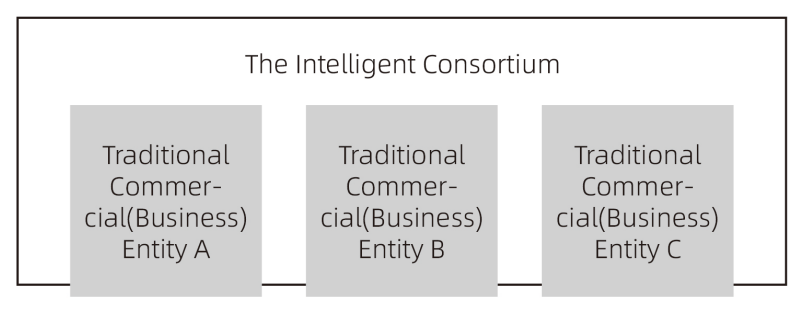
As shown in the figure above, the Intelligent Consortium should be a larger organizational collection than traditional business entities, potentially encompassing one or multiple traditional business entity subsets as tools to realize the organizational intentions of the Intelligent Consortium. These conventional business entity subsets may also be subordinate Intelligent Consortium. However, the real-world relationships and collaboration methods between the Intelligent Consortium collection and its subsets need to be determined based on the commercial forms, purposes, and the organizational network construction preferences of the organizational individuals within each Intelligent Consortium.