The Meaning of Individual Survival and Intelligence Construction
Figure 1
(Reference: 《人人可懂的深度学习》,ISBN:9787111680109)
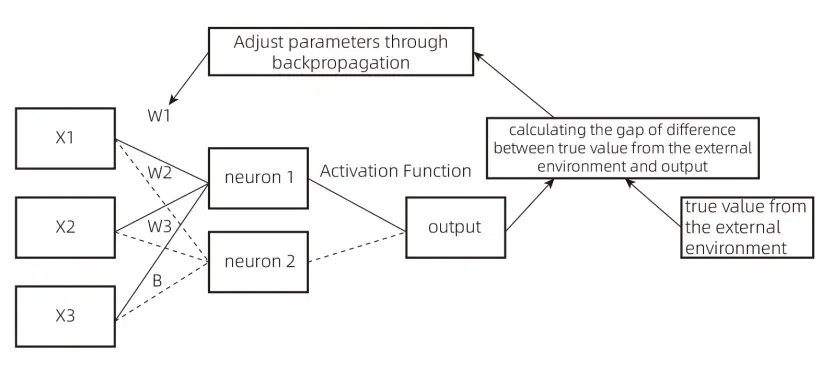
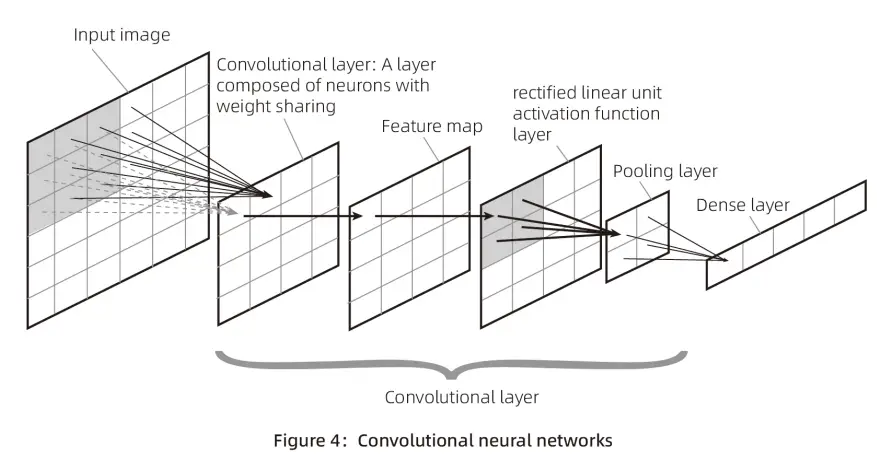
The previous section introduced how artificial intelligence and biological intelligence achieve intelligent construction through a bottom-up mechanism. In this bottom-up construction process, individuals transmit their outputs to higher levels through mechanisms similar to those depicted in Figures 1 and 4 in the “Fundamentals of Machine Intelligence” chapter, followed by top-down feedback from higher levels to adjust and iterate the entire network. Subsequently, intelligence degree was defined as external environment adaptability: the higher the intelligence degree, the stronger the external environment adaptability, which leads to a better living environment, enhanced competitive ability, and greater material rewards.
In the bottom-up construction process of intelligent agents, intelligent agents with a lower intelligence degree form network structures within the system. Through mutual collaboration and continuous adjustment of their parameter settings, weights, and other factors, the newly constructed intelligent agent exhibits a higher intelligence degree.
In artificial intelligence programs, engineers set goals and reward functions for the program to achieve. The closer the program gets to the goal, the greater the rewards it receives. Feedback mechanisms (feedback functions, backpropagation) adjust the parameters and weights of neurons in the program’s network, gradually improving its coherence with the engineer’s set goals.
In nature, cells that form various organisms adapt to their external environment through genetic variation, the survival of the fittest, self-learning, environmental perception, and memory, striving to achieve a better living environment or evolve new survival strategies to thrive in their environment.
Whether in artificial intelligence programs, human society, or nature, individuals seek better ways to align with the external environment to exist better and longer. The construction of intelligent agents is a bottom-up collaborative mechanism formed by individuals to achieve their goals (attaining a higher intelligence degree and thus stronger external environment adaptability). This can involve cells in relation to the biological entity, neurons in relation to artificial intelligence programs, or individuals in relation to societal organizations. From the above, a low intelligence degree implies poorer adaptability to external environments, which means weaker survival competitiveness. Intelligence construction allows individuals to become part of a whole, benefiting from the higher intelligence degree of the whole to enjoy the dividends of greater external environment adaptability.
When revisiting the significance of intelligence construction, the answer becomes crystal clear: through intelligence construction, individuals, as part of a whole, can enjoy stronger external environment adaptability to achieve specific goals (typically survival) of individuals with a relatively low intelligence degree.