The Decision-Making and Execution Unit Structure of the Intelligent Consortium
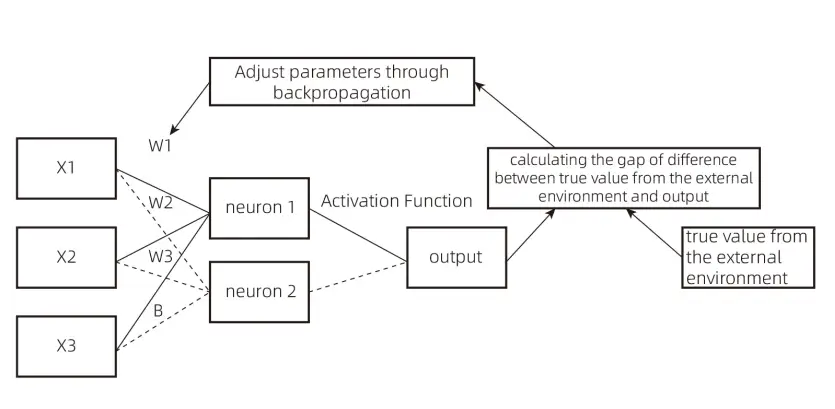
Figure 1:
Figure 1 illustrates the basic structure of a neural network. The Intelligent Consortium refers to inspiration from this framework when constructing its organizational network. However, this does not imply that the overall architecture of the Intelligent Consortium is a replica of a neural network’s basic structure. In the structure shown in Figure 1, the output transmission of each network layer can be likened to the decision-making and execution outputs within the Intelligent Consortium’s organization. In the actual operation of a business organization, the number of decision-making and execution units is neither singular nor fixed and can be numerous. Moreover, different decision-making and execution units involve distinct organizational individuals and tasks with significantly varied content. Therefore, simply modeling the organization mechanically as a neural network framework similar to Figure 1 is impractical, as the diverse output types in the Intelligent Consortium involve different decision-making and execution nodes, as well as complex real-world affairs. Managing various distinct real-world organizational network tasks with a deep learning neural network framework is not feasible.
To address this issue, I propose that within the Intelligent Consortium, each decision-making and execution node should independently construct a deep learning-like network structure. This means multiple network structures, similar to those in Figure 1, will emerge within the Intelligent Consortium, with each network’s final output corresponding to a specific decision-making or execution unit. In other words, each decision-making or execution node is treated as an output unit. Within this structure, each decision-making or execution unit owns a complete neural network structure that can be regarded as an intelligent agent (akin to an agent playing a game under reinforcement learning) that interacts with other decision-making or execution units inside the organization or external environment outside the organization. In the neural network of a reinforcement learning intelligent agent, organizational individuals act as neuronal units, forming the neural network structure that outputs decision results (as shown in Figure 1). Through reward feedback from the intelligent agent’s behavior, internal adjustments are made to optimize decision-making and execution.
Remark: Each decision-making and execution unit possesses its own independent neural network structure (similar to Figure 1).
Please consider an Intelligent Consortium restaurant organization as an example. Based on the theory setting above, multiple complete neural network-like organizational structures should exist within the organization. For instance, procurement as an execution unit is backed by a decision-making unit, such as the procurement manager. The group driving the procurement manager’s decisions forms a neural network-like structure, with the final output being the procurement manager’s instructions to procurement staff. Similarly, chefs, Dining Area managers, and operations managers each have their own complete neural network-like structure, with different organizational individuals (employees, capital providers, and consumers) acting as “neurons” that continuously influence the decision-making and execution units through the corresponding driving mechanisms within the organizational network.