The Concept of Organizational Template and Action Template
To address the challenge of allocating Driving Influence to different driving individuals, the Intelligent Consortium network should establish two modules:
1 . Organizational Template
2 . Action Template
The Organizational Template is predefined during the initial construction of the Intelligent Consortium, serving as a rule template that the Action Template must follow. Before the network is built, potential organizational individuals must establish an initial, mutually agreed-upon Organizational Template, similar to the initialization parameters of software. This template can be determined through voting or negotiation among the initial potential organizational individuals.
As the network operates, this template will inevitably require adjustments and optimizations, which must be carried out in accordance with the rules of the Organizational Template through voting or other fair methods by all existing organizational individuals. The Organizational Template is akin to the network structure design of a neural network. Unlike neural networks, which only adjust weights during training, the Organizational Template not only sets the basic parameters for network operations but also determines the operational methods and network structure in collaboration with organizational individuals or potential individuals with direct interests in the network.
If the Organizational Template is considered a network, its role is to modify the Action Template. The Action Template, as another part of the Intelligent Consortium network, enables the Intelligent Consortium to interact with the external environment and engage in Rights Conversion with other external intelligent agents. Thus, the Intelligent Consortium operates with two main networks: the Organizational Template and the Action Template.
The Action Template must operate in accordance with the rules established by the Organizational Template. For example, in an Intelligent Consortium restaurant, the Organizational Template may define subnetworks within the Action Template, such as consumer opinion groups, procurement supervision groups, or dish evaluation groups, and set basic configurations for their staffing, driving methods, and evaluation methods. In summary, the operational rules and network structure of the Action Template must be defined within the Organizational Template, and organizational individuals and nodes within the Action Template must conduct business operations in accordance with these rules.
All organizational individuals in the Intelligent Consortium should participate in driving the Organizational Template network, while most also serve as Action Nodes or Driving Nodes in the Action Template network. For instance, a restaurant’s chef or procurement officer is an Action Node in the Action Template (cooking, dish development, procurement) and a Driving Node in the Organizational Template, participating in voting or providing suggestions to optimize the Action Template network. Consumers may serve as members of a dish opinion group (Driving Node, offering improvement suggestions) in the Action Template while also participating in the Organizational Template network, alongside chefs, procurement officers, and capital investors, to vote on optimizing the Action Template network.
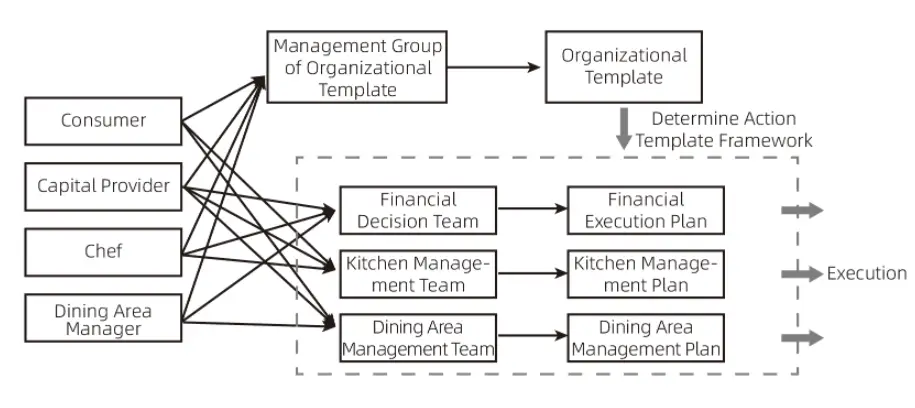
The diagram illustrates a simplified network structure of an Intelligent Consortium restaurant. In this network, four organizational individuals determine the content of the Organizational Template through a template management group, including, but not limited to, defining the structure of the Action Template network. These four individuals also serve as Driving Nodes in different sub-networks of the Action Template, with some acting as Action Nodes to produce outputs. The Action Template comprises three sub-networks: a Financial Decision Team, a Kitchen Management Team, and a Dining Area Management Team, each exhibiting a typical network structure. While real-world Intelligent Consortium networks are inevitably more complex, this simplified structure provides readers with a basic concept of the Organizational Template and Action Template.