Part 2: Construction of the Intelligent Consortium — Construction Arrangements Vision for the Post-Capital Injection Stage (Formation Stage)
1. Establishing the initial state of organizational individuals’ uncompleted rights conversion value (G’ and G’%) and A:
After completing the capital injection and before confirming the overall plans for the organizational and action templates, it is necessary to confirm the actual influence of organizational individuals. Therefore, after the capital injection, the actual calculated values of G’, G’%, and A for organizational individuals need to be confirmed and publicized. After no disputes arise from the public disclosure, organizational individuals can enter the consensus-building mechanism process for the organizational and action templates based on the size of their A values to confirm the initial consensus. In the future, when organizational individuals exit, capital disengagement occurs, or G’ values are adjusted, the organization needs to arrange personnel to periodically recalculate and publicize the actual calculated values of G’, G’%, and A.
2. Completing the first round of confirmation for the organizational and action template plans (organizational template):
After the capital injection, the Intelligent Consortium can proceed with organizational template consensus confirmation based on the established consensus-building mechanisms. At this stage, although capital has been secured, considering that the consensus for the organizational template and the network structure of the action template have not been finalized, the organization has not yet begun operational expenditures. At this point, the injected capital remains in the executing entity’s account, awaiting final confirmation of various elements. If the final consensus of the organizational template does not meet the expectations of all or some capital providers, they may choose to partially or fully disengage their capital. If capital disengagement at this stage leads to insufficient operational capital, the organizational construction process will revert to the organizational improvement stage of the pre-capital injection phase. The process will resume only after organizational individuals secure sufficient new capital injections for another round of consensus confirmation. At this time, unwithdrawn capital should not be used for expenditures but should remain in the executing entity’s account to observe process developments. Given that the organization may face the dilemma of capital withdrawal during the organizational consensus confirmation stage, the scale of injected capital should significantly exceed the organization’s capital needs to avoid operational capital shortages or process stagnation due to partial capital disengagement after organizational confirmation. After reaching consensus on the organizational template, the organization needs to disclose and store relevant information in accordance with the consensus reached in the pre-capital injection stage regarding information storage and disclosure for organizational operations.
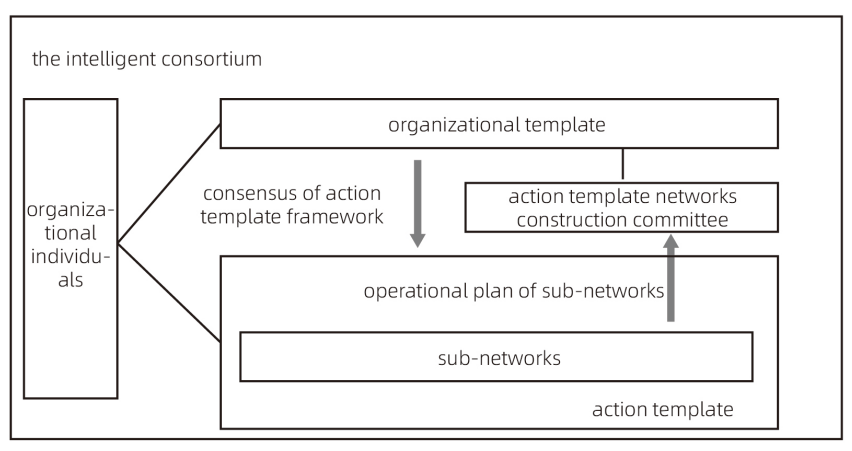
The consensus output from the organizational template should include an action template networks construction committee. This committee’s responsibility is to evaluate the network structure plans, consensus-building mechanisms, and other organizational matters related to the construction of sub-networks in the action template. The members of the action template networks construction committee are determined through the consensus-building mechanism of the organizational template’s organizational network, and the consensus must be reconfirmed by the organizational template network at regular intervals.
3. Personnel allocation, organizational construction for driving nodes and action nodes in each network of the action template:
Once the organizational template plan has reached consensus within the organization, the action template organizational network plan, as an extension of the organizational template consensus, will also be confirmed. After completing the overall framework of the action template network, organizational individuals need to construct the sub-network structure, personnel allocation for driving and action nodes, and corresponding consensus-building mechanisms for the action template network. Different sub-networks consist of specific organizational individuals forming their driving and action nodes. The network structure, driving forms, action forms, and consensus-building mechanisms of sub-networks, proposed by organizational individuals within the sub-network, must be approved by the action template networks construction committee before implementation. These elements also need periodic reevaluation, adjustment, and reconfirmation. Plans submitted to the action template networks construction committee for evaluation should also be disclosed to all organizational individuals through the organization’s information disclosure system, allowing them to discuss, evaluate, review, and supervise the actions.
4. Preparation and personnel deployment for sub-networks:
During the process of confirming the action template structure consensus through the organizational template, a temporary preparation leader needs to be designated for the sub-networks to be constructed in the action template. This organizational individual is responsible for convening network individuals within their sub-network, providing an initial version of the consensus-building mechanism, and reaching consensus with organizational individuals within the sub-network on the final consensus-building mechanism, internal network structure, driving forms, action forms, network operation budget, and subsequent network optimization management matters. The final plan is submitted to the action template networks construction committee for evaluation and confirmation. Once the final plan is evaluated and confirmed, the preparation leader’s duties are completed, and the sub-network will operate according to the final plan.
As sub-networks begin operating according to the plan, it signifies that the Intelligent Consortium has transitioned from the construction phase to the operational phase. At this point, the journey from theoretical proposal to organizational construction concludes, but the story is just beginning. After elaborating on the ideas related to organizational construction, this book cannot provide further visions or introductions regarding network operations. The complexity from theoretical proposal to organizational network operations inevitably increases exponentially, as readers can sense from the length and information density of the book’s chapters. During the network operation phase, different organizational business forms may lead to significant differences in network structures and corresponding sub-networks. Therefore, this phase requires organizational individuals to explore, experiment, and summarize experiences in practice. As mentioned earlier in the plan, after completing the writing of this book, I will also begin practical attempts at constructing the Intelligent Consortium. Perhaps after some time of practice, I can explore various visions, practical operational experiences, and reflective conclusions about the network operation phase in future writings.