Part 2: Construction of the Intelligent Consortium — Construction Arrangements Before Capital Injection
After setting the trigger, organizational construction enters a substantive phase, which is further divided into two stages: 1) the pre-capital injection stage and 2) the post-capital injection stage. The substantive capital injection distinguishes these two stages, and each stage requires corresponding work arrangements. Considering that no substantial capital injection has occurred during the pre-capital injection stage, the organization needs to make personnel, financial, and timeline arrangements based on the consensus reached regarding work arrangements before and after the trigger takes effect. Once personnel are in place, the organization needs to form consensus-building mechanisms and reach consensus on the following content:
- Arrangements for the continuous improvement process of organizational content and development plans:
Whether in the organizational construction phase or after the capital injection, the continuous improvement of organizational content and development plans, along with the corresponding consensus-building mechanisms, must be continually optimized and iterated to achieve a higher-quality new consensus. Therefore, after the trigger takes effect, organizational individuals need to clarify arrangements for continuous development based on the existing organizational content and development plans. Additionally, for the content mentioned below that requires constructing new consensus-building mechanisms and reaching new consensus, specific work arrangements should be clarified. For this ongoing process of expanding consensus, organizational individuals need to publish a corresponding schedule.
- Detailed plans for capital injection and disengagement: (Preliminary plans for capital injection and exit need to be proposed during the commercial plan stage.)
The content of capital injection and disengagement plans should include the equity structure of traditional commercial companies to be established during the organizational construction of the Intelligent Consortium, how to complete capital funding based on the equity structure, how to align organizational development progress with capital injection progress, adjustments to G’, G’%, and A during phased investments, and coordination and response plans for scenarios such as subsequent capital refusing to invest as planned, capital exiting, or new capital entering.
- Organizational template operation plan, and network structure in the Post-Capital Injection stage (consensus-building mechanisms and consensus):
The organizational network of the Intelligent Consortium is divided into the organizational template network and the action template network. After the trigger takes effect, organizational individuals must first propose a comprehensive plan for the network structure and operational mode of the organizational template. This plan is not the final operational plan after capital injection, as the capital injection has not yet been completed. Consequently, the consensus and consensus-building mechanisms corresponding to this plan lack the approval of potential capital providers. This plan, as a preliminary organizational individual plan (including operational and consensus-building mechanisms), is mainly used during this period to introduce and reference potential organizational individuals (including potential capital providers). As communication with capital providers and other potential organizational individuals progresses, the plan will be initially confirmed before capital injection, taking into evaluate the demands of more organizational individuals. The content of the organizational template’s operational plan should include consensus-building mechanisms for the action template and commercial operation plans.
- Action template vision (consensus-building mechanisms and consensus) in Post-capital injection stage:
As introduced earlier in the book, the network structure of the action template is derived from the organizational template during the corresponding consensus-building mechanism process. Therefore, before consensus is reached on the organizational template plan, the network structure and corresponding action plans of the action template cannot be finalized. Although the action template’s content cannot be ultimately confirmed, it is still necessary to propose different plan visions and continuously optimize and adjust them under a temporary consensus-building mechanism.
- Post-capital injection commercial operation plan:
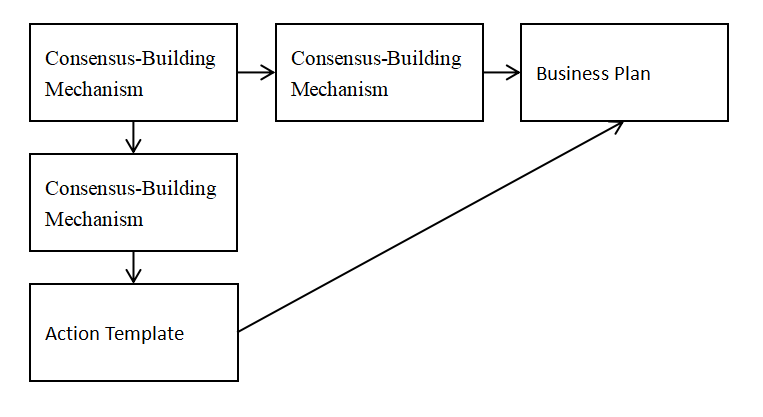
The operational plan primarily refers to the business model and the organization’s commercial plan. Undeniably, the operation plan will be influenced by the organizational template, action template, network structure, and operational plans. However, to promote the organizational construction process, quasi-organizational individuals need to reach consensus on a temporary organizational commercial operation plan within the organizational template’s consensus-building mechanism process based on the temporary organizational and action template framework. As shown in the figure below, the organizational template of the organizational network exerts a critical influence on the Intelligent Consortium organization by establishing consensus-building mechanisms for commercial plans and action template content. The action template organizational network, during the subsequent organizational operation phase, functions through driving nodes and action nodes in sub-networks to implement the commercial plan that has reached consensus.
- Post-capital injection personnel management plan (consensus and consensus-building mechanisms):
The personnel management plan mainly refers to the configuration, recruitment, and selection plans for organizational individuals providing labor within the organization. The selection plan’s content primarily covers the selection plans for personnel corresponding to different network nodes in the organizational network. The information disclosure content of the selection process includes the decision-making process, personnel information, and information about staff involved in the selection process. Regarding the disclosure of the personnel selection process, the organization can conduct personnel selection in a video-recorded environment and achieve transparency through live streaming or subsequent video uploads. The personnel management plan must be confirmed only after relatively complete plans for the organizational template, action template, and commercial plan have been established. Considering that the initial personnel management plan is proposed during the pre-capital injection stage by temporary staff, quasi-organizational individuals, and potential organizational individuals, it cannot be clearly determined which sub-organizational network(action template) it should belong to during actual operation. However, at the initial proposal stage, the issue of staff network affiliation and their preliminary confirmation in the corresponding plans of the action template and organizational template should be addressed.
- Post-capital injection financial arrangements (budget, financial system, etc.):
Once the organization has formulated temporary plans and reached consensus on the organizational template, action template, commercial plan, and personnel management plan, it can propose temporary financial arrangements for post-capital injection based on these. Financial arrangements include, but are not limited to, financial budgets, expected capital injection scale, financial systems, and financial-related network operation methods. Since financial arrangements may play a relatively important role in the subsequent capital injection process, they should also include profit expectations, capital injection procedure, equity structures constructing suggestion for capital injection, and response plans for partial capital withdrawal.
- Post-capital injection third-party platform or proprietary platform application plan:
Before completing the capital injection and finalizing the confirmation of various plans, it is necessary to publish plans that require consensus and provide a fair platform for organizational individuals to discuss and implement consensus-building mechanisms regarding plan content, operational status, and future improvement directions. Therefore, organizational individuals need to reach consensus on the selection of a platform for implementing consensus-building mechanisms, information dissemination, and opinion discussions.
- Information storage and disclosure for organizational operations:
After completing platform selection, organizational individuals need to reach consensus on which information needs to be disclosed and how it should be stored. Information disclosure channels may require permanent retention and irrevocability features, and information storage should also incorporate a certain degree of decentralization. Considering that the Intelligent Consortium may lose control over certain executing entities due to capital disengagement (read the content in Considerations and Visions for Capital Injection below), the platform and method for information disclosure and storage should not be affected by the loss of control over executing entities; otherwise, the Intelligent Consortium may collapse due to such loss.
- Project promotion to various potential organizational individuals and other external groups:
The project promotion process is mainly aimed at expanding the number of potential and quasi-organizational individuals. Its content includes not only expanding information dissemination but also information collection, feedback, and optimization plans for the aforementioned plans. Potential organizational individuals may become labor providers, consumers, or suppliers of services and goods for the organization in the future.