Part 2: Construction of the Intelligent Consortium — Considerations and Visions for Capital Injection
Definition of Capital Injection:
Capital injection for the Intelligent Consortium organization typically refers to the process by which capital providers invest funds to participate in organizational development and become organizational individuals. However, it does not rule out the possibility that some organizational individuals substitute funds with labor, raw materials, services, production materials, or the right to use real estate (properties) to achieve an alternative form of capital injection. In such cases, these organizational individuals are also considered capital providers, and their actions are defined as capital injection.
During the pre-capital injection stage, the Intelligent Consortium and its organizational individuals need to reach consensus on the forms of capital injection to be accepted, how to price the interest on the capital injection, and how to allocate shares in traditional commercial entities. They should also publish the consensus content to support the organization’s commercial promotion.
Operational Structure of the Intelligent Consortium and Capital Injection:
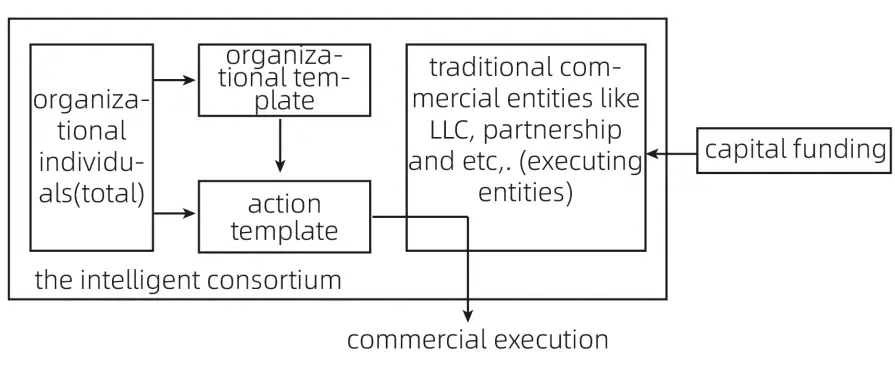
The figure above is a simplified diagram of the Intelligent Consortium’s actions, where capital injection is primarily reflected as investments in traditional commercial entities, and capital providers simultaneously become shareholders of the conventional commercial entities (executing entities) within(under) the Intelligent Consortium. The commercial actions of the Intelligent Consortium, such as sales agreements, personnel hiring, and financial transactions, are primarily carried out through the traditional commercial entities within the Intelligent Consortium. In this structure, organizational individuals other than capital providers are highly unlikely to be shareholders of the executing entities. Capital providers not only act as shareholders of the executing entities but also participate in the construction of the organizational and action templates of the Intelligent Consortium as organizational individuals and may participate in organizational operations in other types of organizational individual capacities.
In the framework shown in the figure above, the content related to the organizational and action templates, including but not limited to consensus-building mechanisms, consensus results, organizational data, organizational individual information, operational data, and customer information, does not belong to the executing entities but is owned by all organizational individuals in a distributed manner. In the case of capital disengagement, the Intelligent Consortium organization can establish new executing entities and implement new capital injection plans to address capital disengagement or replace certain shareholders of the original executing entities, thereby achieving partial capital disengagement. Specific response plans depend on the characteristics of the real-world scenario. When some organizational individuals substitute funds with labor, goods, or services to achieve capital injection, these organizational individuals become shareholders of the executing entities as capital providers, with no substantive difference from capital providers who invest cash.
In this framework, even if capital disengagement leads to the paralysis of executing entities and the organization must temporarily stop commercial activities using commercial entities that experienced capital disengagement, the organizational structure, information system, and personnel system of the Intelligent Consortium remain intact. This means the Intelligent Consortium only needs to complete new capital injections and establish new executing entities to continue operations. However, organizational individuals must still consider the interests and demands of capital-providing organizational individuals when reaching consensus on the organizational and action templates. Although the Intelligent Consortium grants greater influence to non-capital-providing organizational individuals in terms of capital injection, the organization cannot conduct organizational actions without sufficient capital supply. Therefore, the Intelligent Consortium must achieve organizational construction and operation based on consensus among various types of organizational individuals and a high degree of organizational approval.