Outlook of Intelligenism and The Intelligent Consortium
1. With the development and popularization of Intelligenism, the number of Intelligent Consortiums will increase. This will lead to intricate networks of relationships among individuals, Intelligent Consortiums, traditional commercial entities, and even AI programs, forming a complex, nested structure of mutual interdependence. As the number of Intelligent Consortiums grows, network complexity will rise exponentially, with mutual influence and driving forces among Intelligent Consortiums, individuals, and traditional organizations. As Intelligent Consortiums continue to develop, their intricate networks may stack to form higher-order Intelligent Consortiums, composed almost entirely of other Intelligent Consortiums and traditional Cybernetics organizations. With stronger resource integration capabilities, these higher-level entities may venture into commercial fields that require significant human and material resources, thereby forming a multidimensional network structure.
2. As Intelligent Consortiums emerge, individuals will have more diverse options when choosing organizations they want to work for. Greater choices will lead to competition among organizations in terms of structure, form, and development philosophy. The unique characteristics and operational effectiveness of Intelligent Consortiums may enable more individuals to choose employment opportunities that benefit them most. The inherent traits of Intelligent Consortiums and their commercial competition with Cybernetics organizations may help reshape labor-capital relationships in society and serve as a potential tool for reducing wealth disparities.
3. As AI advances, simple, online execution tasks performed by organizational individuals may gradually be replaced by intelligent programs, potentially lowering the organizational and social status of individuals engaged in such tasks. This will also rapidly reduce the cost of implementing such tasks, increasing the overall societal value of creative and collaborative work. In this trend, individuals will need to redefine their value within society and organizations. Under the Intelligent Consortium framework, individuals will take on more decision-making and collaborative tasks, participating as intelligent agents in the network’s operations. Such decision-making and collaborative work forms generate new organizational value outputs that seem more difficult to replace by AI.
4. Considering the bottom-up, neural network-like structure of the Intelligent Consortium, its organizational individuals (akin to neurons) participate as intelligent agents in decision-making and driving processes. In this framework, AI, as an intelligent agent, can also function as an organizational individual within the Intelligent Consortium network, collaborating with human individuals in a bottom-up intelligent network for decision-making and driving. Organizational individuals may delegate part or all of their Driving Influence Weight Ratio to designated AI programs or grant AI partial influence weights in specific sub-networks with organizational consensus. In this hybrid human-AI neuron system, the resulting larger network may integrate the intelligence value of both humans and AI, creating a more intelligent organizational network that surpasses individual humans or AI.
AI and Human Collaborative Driving Diagram 1:
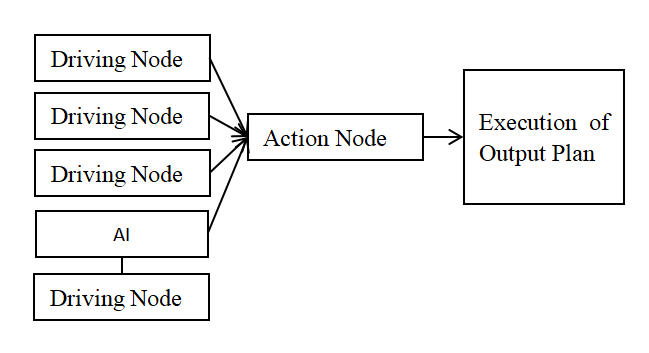
5. As described in the construction of the Intelligent Consortium, setting initial development goals, consensus-building mechanisms, and development plans is essential, as are subsequent discussions and voting processes. In the process of continuously expanding and optimizing consensus, large-scale AI models can analyze information generated from organizational individuals’ comments, votes, and other consensus-building activities, outputting improved business models, consensus schemes, and operational plans. This means that forum discussions, opinion expressions, likes the work got in the forum, and votes—common in Connectionism-based bottom-up governance—can serve as data sources for AI models, which, together with AI, can continuously drive organizational development and optimize various schemes.
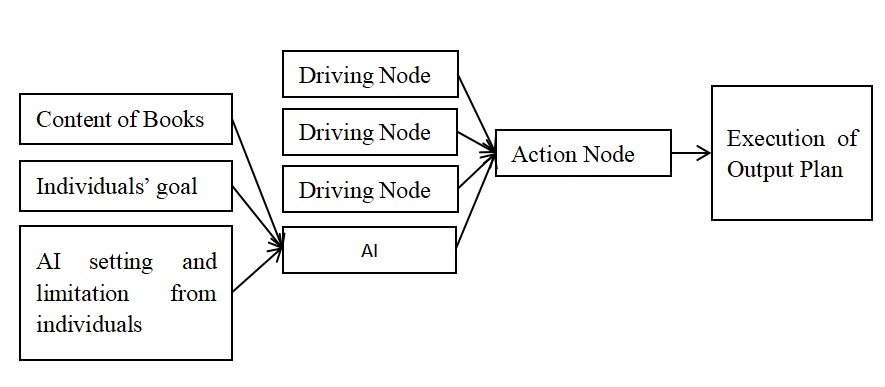
6. Under the collaborative framework of Intelligenism, AI can not only serve as Driving Nodes, as mentioned in the 4th section, but also be regarded as a sub-network within the Intelligent Consortium. By managing the information input and feedback of AI intelligent agents (sub-networks), their behavior can be influenced. In this process, human organizational individuals can input organization-generated information, as described in Section 5, and feed the entire content of this book to AI intelligent agents, enabling them to understand the theoretical logic of Intelligenism fully. By providing the book’s content, individual methods, and goals, organizational individuals can enable AI to generate solutions based on the overall theoretical framework of Intelligenism. Individuals can even feed multiple books from different theoretical systems to AI to explore further theoretical innovations. In this approach, this book and others serve not only as sources for human knowledge and new concepts but also as data sources for AI participation in decision-making analysis.
AI and Human Collaborative Driving Diagram 2:
7. With the development of blockchain technology and the Intelligent Consortium, the distributed storage and immutability of blockchain can combine with intelligent contracts and digital currency-related technologies to create a more advanced form of the Intelligent Consortium. This new form may address the current legal inability to enforce novel organizational rules, providing stronger enforceability, safeguards, and fairness for the Intelligent Consortium’s organizational design and the interests of its organizational individuals. The Intelligent Consortium also offers blockchain-based commercial models, more practical tools, and approaches for real-world implementation.