Information Transmission Characteristics of the Intelligent Consortium
Information Transmission Diagram of the Intelligent Consortium:
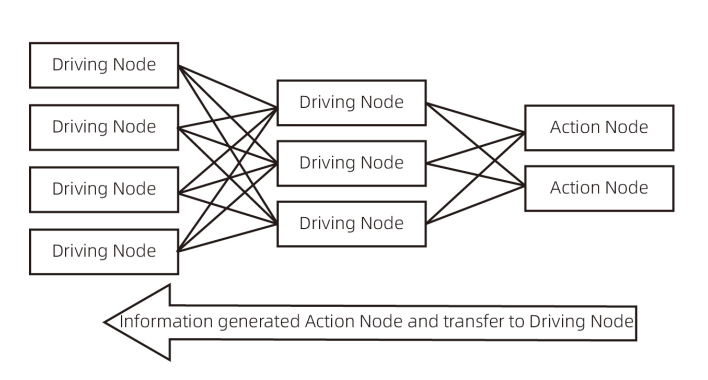
In the organizational network of the Intelligent Consortium, action nodes generate information through executing actions and then feed it back to driving nodes. In the network structure shown in the diagram, each action node is connected to three driving nodes, and each driving node connected to an action node is further connected to four other driving nodes. This means that the information feedback from an action node is first transmitted to three driving nodes, which then pass it to four subsequent driving nodes. In this organizational network, information transmission exhibits a diffusion pattern, meaning information is more easily disseminated to a larger number of organizational individuals.
Information Transmission Diagram of a Cybernetics Organization:
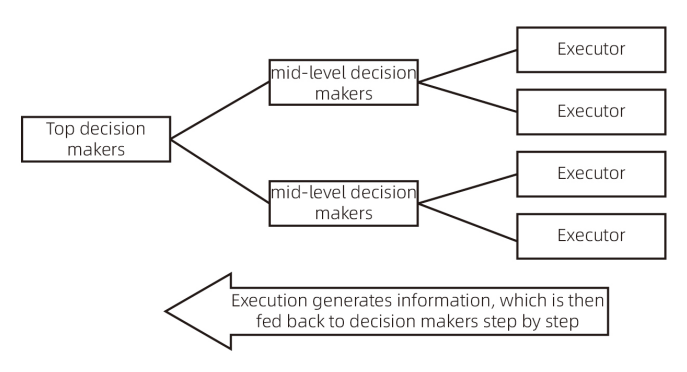
In a cybernetic organization, execution units generate information through interactions with the external environment and report it to their immediate superior (mid-level decision-making unit), who organizes and adjusts the information before reporting it to the top-level decision-making unit. In this structure, all execution unit information is transmitted in a single line, from “execution unit → mid-level decision-making unit → top-level decision-making unit.” Outside this single-line transmission, other organizational individuals have difficulty gaining comprehensive and direct access to the information. The black-box nature of this single-line transmission means that when errors or distortions occur, top-level decision-making units struggle to verify or correct the information through multiple sources.
Simplifying things leads to the filtering of the information they contain, as mentioned in From the Mystical Characteristics of Wave Theory to the Dilemma of Defining Things. Because the definition boundaries of things are typically somewhat fuzzy, and cybernetic organizations must define them. Within the information transmission pipeline, the fuzzy boundaries of things may be arbitrarily delineated (forcefully quantified or qualified) during transmission, leading to the loss of significant detailed information and analytical direction. Therefore, in a top-down control process, whether it is the process of decision-making units receiving information (information simplification) or issuing directives (arbitrary delineation), the information about things loses its flexible definition and evaluation space. In the Intelligent Consortium, decision-making is bottom-up, with each driving node having different information understanding and definitions. The output of action nodes can be influenced by different driving nodes, meaning the final delineation method is affected by more information. Although this influence is indirect, the involvement of more information and definition methods makes the output more aligned with the real external environment (reducing information loss from simplification and deviations in individual information transmission).
By comparing the two information transmission diagrams, it can be seen that the information transmission in traditional cybernetic organizations is one-to-one pipeline transmission. The limited information reception and processing capacity of top-level decision-making units means they cannot devote excessive effort to verifying bottom-up information reports. However, the connectionism-based structure of the Intelligent Consortium requires an action node to provide information feedback to multiple driving nodes. In smaller networks, these driving nodes act as action nodes in sub-networks, feeding information to more driving nodes in those sub-networks. This transmission results in an exponential increase in the number of information recipients, ultimately ensuring that nearly all organizational individuals are aware of organizational operations. This one-to-many information transmission means that individuals providing information are accountable to multiple parties, significantly increasing the risk for the information provider if information is deliberately concealed or unintentionally erroneous. Additionally, the mutual collaboration among organizational individuals enables information from different action nodes to spread quickly to most individuals in the organization, and logical contradictions in the information provide opportunities for some individuals to identify transmission errors, significantly increasing the difficulty of falsifying or concealing information.