Definition of Action Nodes and Driving Nodes
The decision-making and execution units mentioned above refer to the final output layer in a neural network, where the output signifies the organization taking action. In the Intelligent Consortium, decision-making and execution are two forms of behavior, often intertwined within each organizational individual. Thus, these two forms are collectively referred to as actions, and decision-making and execution units are collectively called action nodes.
In a neural network, the output result is supported by numerous neurons responsible for parameter adjustments and computations. In the Intelligent Consortium, as mentioned earlier, each action node (output behavior) has its own independent neural network structure, meaning that some or all organizational individuals can serve as neuronal nodes within the neural network corresponding to that action node. These neuronal nodes (organizational individuals) primarily drive the action nodes by exerting influence through methods such as suggestions, supervision, voting, appointments, or rule-setting. In this framework, all nodes in the network, except the action nodes, are referred to as driving nodes.
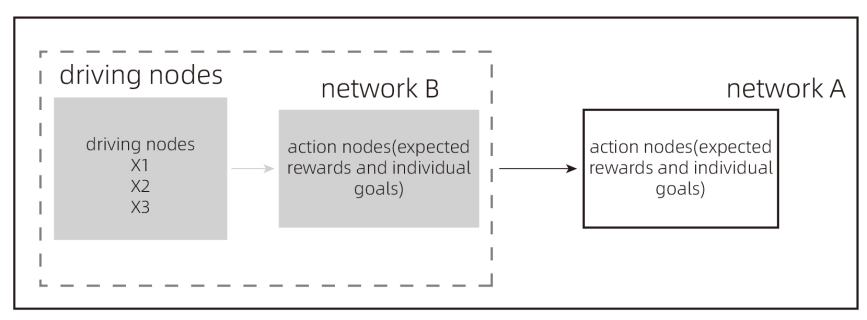
NOTICE: Network B is a sub-network(driving node) of network A.
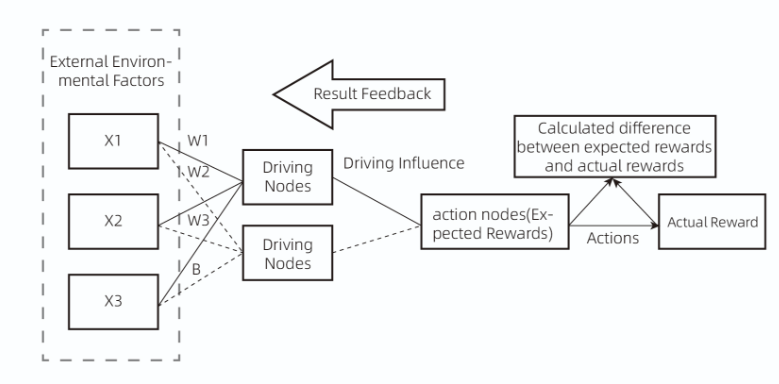
At the same time, a driving node in one network may serve as an action node in another, smaller subnetwork. For example, a restaurant’s procurement team consists of three members, each corresponding to an action node. At the level above the procurement team, it is driven by a finance team, a supervisory team, a consumer opinion leader group, and other teams. The final opinions or delegated representatives from these teams can be considered driving nodes, which influence the procurement team and its three action nodes through supervision, suggestions, appointments, or reward/punishment mechanisms. Upon further analysis of the finance team, it consists of two financial staff members who evaluate procurement information and process payments. These two staff members are also action nodes for the organization’s financial behavior. As mentioned earlier, each decision-making and execution individual can be understood as an action node, with each action node having a complete network structure, and the driving nodes within that structure may also be action nodes in another network (with decision-making and execution functions).
(To simplify the discussion, decision-making and execution units will henceforth be referred to as action nodes.)